






PA300 Detailed Introduction
Product Description
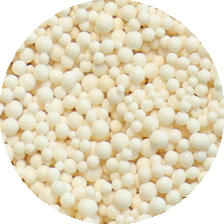
Pure PA300 is a macroporous polystyrene weak-base anion exchange resin having tertiary amine functionality. Pure PA300 has superior kinetics and greater resistance to oxidation and osmotic shock, high chemical and physical stability.
Applications
Pure PA300 is intended primarily for use in multiple bed demineralizers. It can be used in a two- bed system following a strong acid cation exchanger such as Pure PC003 where weak acid ions (silica and carbon dioxide) do not have to be removed. Pure PA300 can also be used in a separate bed, ahead of the strong base exchanger to remove organics and strong acid ions.
|
Typical Physical & Chemical Characteristics |
|
|
Polymer Matrix Structure |
Macroporous Polystyrene with DVB |
|
Functional Group |
R-N-(CH3)2+ |
|
Ionic Form, as shipped |
Free Base |
|
Physical Form And Appearance |
Spherical Beads |
|
Sphericity |
95% min. |
|
Screen Size Range |
16-50 mesh, wet |
|
Particle Size Range |
+1.2 mm < 5%, -0.3 mm < 1% |
|
Uniformity Coefficient |
1.6 max. |
|
Water Retention, Free Base |
50-60% |
|
Swelling Free Base → Cl- |
20-30% |
|
Shipping Weight, Free Base |
650-720 g/l (42 lbs/cu.ft, approx.) |
|
Total Exchange Capacity, Free Base |
1.45 eq/l min. |
|
pH Range |
0-14 |
|
Suggested Operating Conditions |
|
|
Maximum Temperature Free Base |
80ºC (176ºF) max. |
|
Minimum Bed Depth |
0.6 m (24 inches) |
|
Backwash Expansion |
50-75% bed expansion |
|
Regeneration |
2-6% NaOH |
|
Displacement Rinse Rate |
Same as Regenerant Flow Rate |
|
Displacement Rinse Volume |
10-15 gallons/cu.ft |
|
Fast Rinse Rate |
Same as Service Flow Rate |
|
Fast Rinse Volume |
35-60 gallons/cu.ft |
|
Service Flow Rate |
16-32 BV/h (2.0- 4.0 gpm/cu.ft) |
|
Hydraulic Properties |
|
|
|
|
|
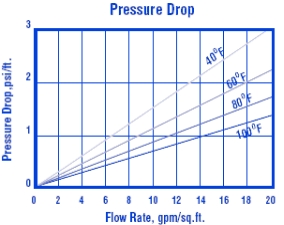
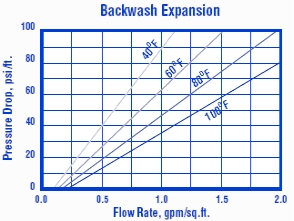
Pressure Drop: The graph above shows the expected pressure loss per foot of bed depth as a function of flow rate at various temperatures. |
Backwash: After each cycle the resin bed should be backwashed at a rate that expands the bed 50 to 75 percent. This will remove any foreign matter and reclassify the bed. The graph above shows the expansion characteristics of PA300. |

 浙公网安备 33060402001250号

